
Beowulf whistle
Yet another theory.

When I was a wee lad, studying Anglo-Saxon poetry and liking it a lot, I was introduced to the august explorations of Joseph Sievers in the matter of Anglo-Saxon prosody. At the same time, I was doing a fair amount of Latin and Greek verse. Now I have always taken a keen interest in prosody, in various languages, and I remember thinking that Sievers’ system made glyconics and alcaics look like child’s play. Surely, I thought, it can’t possibly be this complicated.
No disrespect to the great Sievers, who will always be deservedly venerated by students of Anglo-Saxon, but I’ve always wondered, over the years, how and why such an extraordinarily diligent and learned man ended up with something so like the Ptolemaic cosmos, with centric and excentric scribbled o’er. I suspect he may have set out with a purely taxonomic intent. But there’s no such thing as pure taxonomy, purely empirical; we always approach our material with categories in our minds, things we look at and things we don’t. And let’s face it, we’re also all, and always, looking for a pattern.
So I think it was with Sievers. He started from the obvious – the metre of Anglo-Saxon poetry is accentual, not quantitative; and alliteration marks something like its “feet”, or perhaps, more accurately, its metra. Oh, and there’s a caesura that divides the line into half-lines. He could have just catalogued the half-lines he found, but his systematizing impulse – which we all share – wanted to construct a typology. And here he ran into an unfortunate fact about English.
Word-stress in English – apart from dialect and idiolect differences – is generally quite clear-cut. No native English speaker ever has or ever will pronounce the word “fellow” with the accent on the second syllable.
But sentence stress is another matter. In fact, no two English speakers will be found to agree on where the stress should go in any sentence of non-trivial complexity. Even very simple ones, for that matter: Say “Jane has a dog”. The speaker will stress “dog” if he’s trying to point out that Jane does not have a cat instead, and “Jane” if he’s listing those of his friends who have pets, and possibly even “has” if he’s correcting somebody who thinks Jane had a dog.
It gets worse. Clearly there are degrees of stress. There are secondary stresses, everybody agrees, but there’s even less agreement about them than about primary stress.
In any actual out-loud utterance it’s easy to hear where the speaker has actually placed the sentence stresses, and what relative degrees of stress he’s used. But you can’t read these suprasegmentals off a text. They’re simply not given by the form or even the semantics of a sentence.
Sievers, attempting to make some sense of the patterns he found in Anglo-Saxon verse, found himself driven to postulate certain kinds of secondary stresses as constitutive elements of types of half-lines. But since secondary stresses are even trickier than primary ones, I fear he only succeeded in landing a second roundhouse punch on the Tar Baby’s jaw.
Putting it a different way, Sievers’ approach to defining the half-line was a constructional one: In what ways can we string together a series of stressed and unstressed and half-stressed syllables to make a kosher Anglo-Saxon half-line? Mutatis mutandis, this is the time-honored approach used in the analysis of Greek and Latin metre: A dactyl consists of either one long syllable plus two sort ones, or a long syllable plus another long syllable. Long syllables being twice the length of short ones, this means that the two forms have the same duration. This leads to some oddities: the iamb for example can be long-long or short-long, and here it would seem that the two forms don’t have the same duration.
I think the solution to this problem lies in approaching it from the other direction: what you might call a subdivision of the foot rather than an assembly of it. That is, assume that all feet have the same duration and then figure out how you are allowed to subdivide it. Long syllables within a foot will still be longer than short syllables in the same foot, but a long syllable in one foot may not be the same length as a long syllable in another foot.
Without going into more detail about Greek, let me just note that I think a similar approach – subdividing rather than assembling the metron, or in the Anglo-Saxon case, the half-line – is the right way to look at Anglo-Saxon metre.
Let’s step back and look at it another way. Say I’m the bard, and I go on in five minutes in the big room at Hroþgar’s. My audience is a couple of hundred drunk guys with spears, who just got back from a nice massacre in Frisia. They want a story about a hero, and they want me to sing it, and by Wotan they want rhythm. Something they can pound their spear-butts to. March time! I hasten to add that they are connoisseurs – they’ve heard a lot of epics, and they have very clear ideas about what they like. But they certainly don’t have Sievers’ types and subtypes in their heads, just as concert-goers these days may love music and have excellent taste, but mostly couldn’t tell you what a hemiola is.
So here’s my stake-in-the-ground idea. It can certainly be refined, and every musician knows that the score is one thing and the actual performance is another, but you gotta start somewhere.
I think Anglo-Saxon poetry was highly rhythmical. In fact I think the Anglo-Saxon poetic line consists of two musical measures, of equal length. So each half-line gets a measure, more or less. Though sometimes one half-line will take up less than a measure, and the other will expand correspondingly. This is all very familiar, daily practice, in setting verse to music, by the way, with anacruses and pick-ups and so forth.
Now there are various ways to divide up a measure. We call these “time signatures” in the music we know best. For example, you can divide a measure into two big beats and subdivide each of those into three – we call this 6/8 time. Or two big beats, each subdivided into two, and we call this 4/4 time. This is a very usual time signature, especially for popular music; so usual, in fact, that we call it “common time”. There are many other possibilities.
Four/four is what I’ve gone for, as being a kind of default position, in the example below. 6/8 time would work too, but I think 4/4 fits better. Call it musician’s intuition.
This approach enables us to use techniques for subdividing the beat, and fitting music to words, which are commonplace – every popular song has them – in Western music, and retire Sievers’ bewildering menagerie of subtypes to the Museum Of Teutonic Ingenuity.
I’m sure I’m not the first person to think of this, but a bit of online digging hasn’t turned anything up.
I could go into more detail, but a picture is worth… well, you know the proverb. Here’s the first few lines of Beowulf. As you’ll see, the caesura mostly coincides with the bar-line, except where the second half-line has an anacrusis (a “pickup”, for the musicians); and for the same reason, the first half-verse of a line sometimes intrudes on the end of the previous line1.
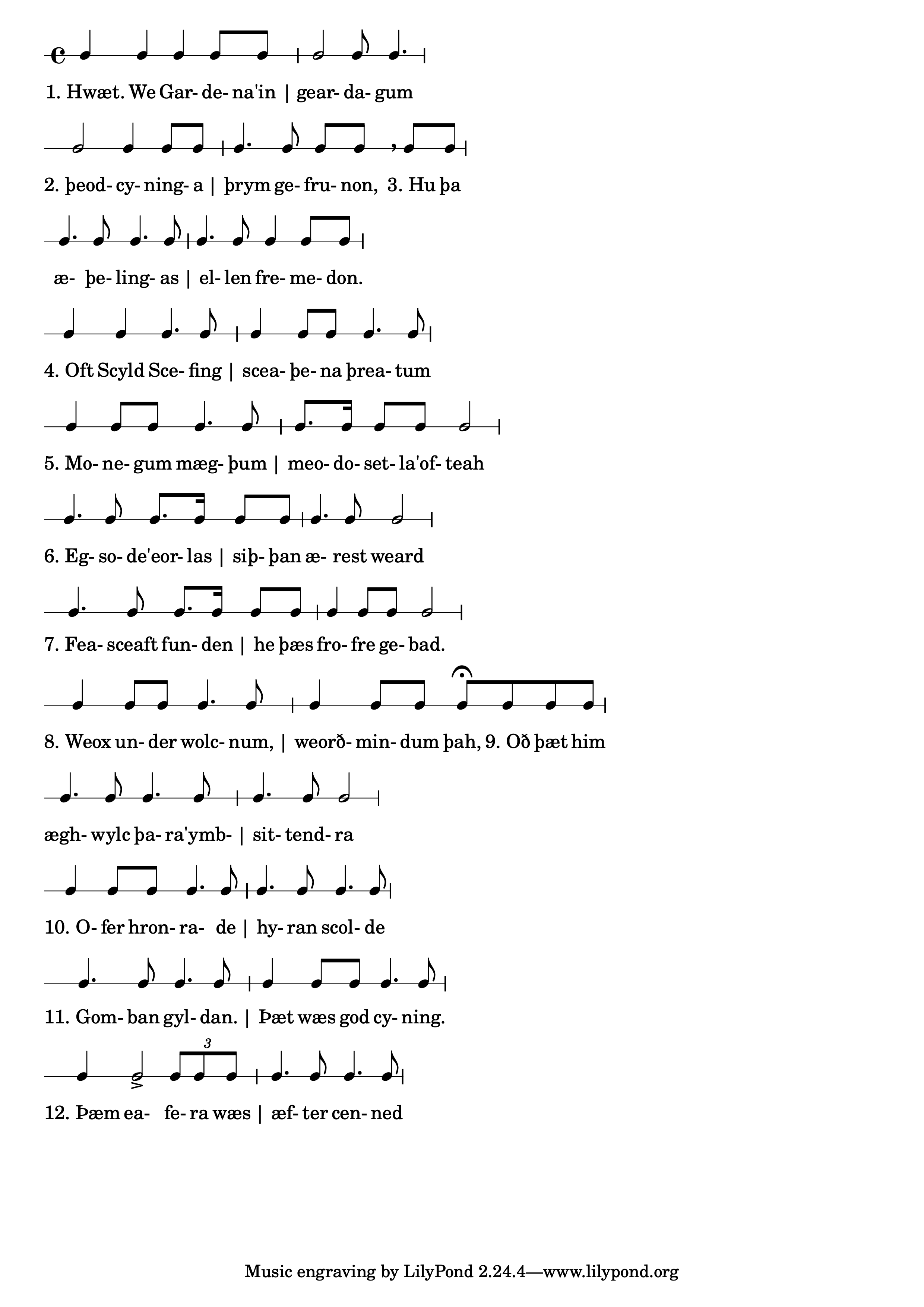
The sharp-eyed will have noticed that I’m indulging, or allowing my bard to indulge, in “crasis”, sometimes called elision: that is, where one word ends in a vowel and the following word begins with a vowel, the two syllables coalesce into one. See verses 1, 5, and 9. This occurs in all Western poetry known to me, from Homer to the present day. I’m not aware that anybody has proposed that it was a “thing” in Anglo-Saxon poetry, but why the hell not? Vowel hiatus is ugly, which is why, according to the ancients, crasis happens in the first place. It’s ubiquitous in ordinary speech, which is why we have forms like “he’s” for “he is”. It makes the verse more compact and dense — raising, you might say, the sense/syllable ratio — always a virtue in poetry. And it makes the poet’s life easier.
the finished product is fascinating, more so if you could work up a performance, a professional one, to demonstrate. let's hear those phat Teutonic beats! i have zero clue on the subject, so maybe it's been done? But the journey to the end....I confess: sleepy time. You didn't get to that point w/o grappling with a subject i've always hated: meter. in any language. kudos to you. i learned just enough classical meter not to embarrass myself completely in Homer and Ovid. thanks for the discussion of dactyls. I didn't have to think so hard about that one. (isn't Krasis the guy who fought the rebel slave Sparta?) anyway, do we have much knowledge on the history of performance? who would perform? what instruments? a solo performer or ensemble? any women performing?
I guess football and ICE detentions have replaced massacres in Frisia for the most part. Has the movie & TV series (Friday Night Lights), and perhaps the popular song, replaced the epic poem? I know smatterings of mainly five languages, including Anishinaabemowin and Cebuano, as well as English, Spanish & French, and have mainly noticed the differences in pronouns and prepositions (English seems to have much complexity). Obviously the epic poem is not lost to you. But what's become of the rest of us?